
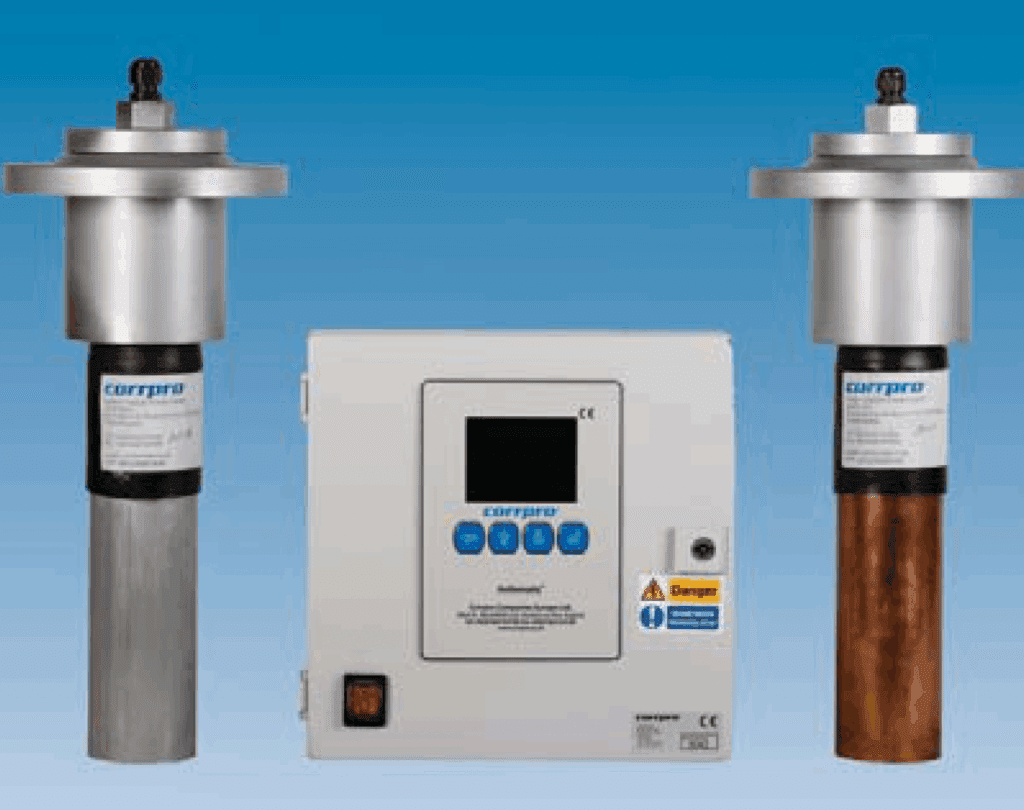
Any vessel or offshore structure that draws seawater through its pipework has a biofouling problem waiting to happen. Seawater carries the larvae of mussels, barnacles and other marine organisms, and given the chance they settle and grow inside cooling and firewater systems, restricting flow, reducing heat exchanger performance and, in a firewater system, threatening a safety-critical function. A marine growth prevention system, or MGPS, stops this fouling at source.
This article explains how an MGPS works, the role of its anodes, and where the technology is applied across ships, FPSOs and offshore platforms.
The problem: biofouling in seawater systems
Seawater cooling systems and firewater systems draw raw, untreated seawater through sea chests, strainers, pipework, pumps and heat exchangers. Without protection, marine organisms settle on these internal surfaces and multiply. Mussels and barnacles are the most damaging, narrowing pipe capacity, blocking strainers and coating heat exchanger tubes until flow and cooling efficiency fall. In a firewater system, the consequences are more severe, as the system must be capable of delivering full flow on demand.
Left untreated, biofouling leads to lost performance, unplanned maintenance and downtime.
How an MGPS works
A marine growth prevention system prevents fouling by dosing the seawater with copper ions at a controlled, very low concentration. Corrpro Europe manufactures the Anfomatic MGPS, which applies a direct current to copper anodes mounted in the seawater system, usually in the sea chest or a dosing tank. The current releases a precisely controlled quantity of copper ions into the water, creating an environment in which the primary forms of marine life do not settle or develop.
The dose is small enough to prevent fouling without harming the system, and the process is automatic and continuous, requiring minimal intervention. Because the copper ions are carried throughout the seawater system by the flow, the whole circuit downstream of the anodes is protected, not just the point of dosing.
The anodes in an MGPS
The anodes are the heart of a marine growth prevention system, and different anode materials perform different functions:
- Copper anodes: the primary antifouling anode. Current applied to the copper releases the copper ions that prevent marine growth.
- Aluminium or ferrous anodes: these release a floc that helps reduce corrosion of ferrous components within the seawater system, protecting the pipework as well as keeping it clear.
- Iron anodes: used where the system contains cupro-nickel pipework, to provide the correct dosing and corrosion control for that material.
The anodes are consumed as they work and are replaced periodically. Selecting the correct combination and size of anodes for the flow rate, pipework material and system volume is central to the design of an effective MGPS.
MGPS and cathodic protection: different jobs
It is worth being clear about the distinction between an MGPS and a sacrificial cathodic protection system, because they are often fitted to the same vessel and are easily confused. A cathodic protection system protects the external submerged steel of a hull or structure from corrosion. A marine growth prevention system protects the internal seawater pipework from biofouling, and helps control corrosion within those circuits. One guards the steel against corrosion; the other keeps the seawater systems clear and flowing. Many vessels need both.
Where MGPS is used
Marine growth prevention systems protect any asset that relies on raw seawater circuits, including:
- Commercial vessels and naval ships, protecting engine cooling and auxiliary seawater systems.
- FPSOs and offshore platforms, where continuous seawater cooling and firewater systems run for years without dry-docking and cannot be allowed to foul.
- Seawater intake and cooling systems more generally, including those serving potable water distillation plant, which can continue to operate without interruption.
- Offshore firewater and intake pump systems, where seawater pumps and distribution pipework must remain fully available and capable of delivering design flow on demand in an emergency.
On FPSOs and platforms, a common upgrade is the conversion of obsolete chlorination antifouling systems to copper dose. Where older electrochlorination plant has reached the end of its life, an Anfomatic copper-dose MGPS offers a proven, lower-maintenance replacement that keeps seawater systems clear without a major system overhaul.
A UK MGPS manufacturer with marine heritage
Corrpro Europe designs and manufactures the Anfomatic marine growth prevention system in the UK, and supplies MGPS anodes, power and control units, replacement parts and servicing for both current and legacy systems. Through its Wilson Walton marine heritage, Corrpro has supplied antifouling and marine cathodic protection to vessels and offshore structures worldwide for decades, and as the original equipment manufacturer it supports installed systems with genuine parts and engineering advice over their full service life.
Frequently asked questions
What is a marine growth prevention system (MGPS)?
A marine growth prevention system is an antifouling system that stops marine organisms such as mussels and barnacles from settling and growing inside a vessel’s seawater cooling and firewater pipework. It does this by applying current to copper anodes to dose the seawater with a controlled, very low concentration of copper ions.
How do MGPS anodes work?
Current is applied to copper anodes mounted in the seawater system, releasing a controlled quantity of copper ions into the water. The copper ions create an environment in which marine life does not settle or develop. Aluminium or ferrous anodes may also be used to reduce corrosion of components, and iron anodes are used with cupro-nickel pipework.
What is the difference between MGPS and cathodic protection?
A cathodic protection system protects external submerged steel, such as a hull, from corrosion. A marine growth prevention system protects internal seawater pipework from biofouling and helps control corrosion within those circuits. They do different jobs and are frequently fitted to the same vessel.
Can an old chlorination antifouling system be replaced with an MGPS?
Yes. Obsolete electrochlorination antifouling systems can be converted to a copper-dose marine growth prevention system such as Anfomatic. This is a common upgrade on FPSOs and offshore platforms, providing a proven, lower-maintenance alternative without a major system overhaul.
To discuss a marine growth prevention system, MGPS anodes or a chlorination-to-copper-dose conversion, contact our marine department or explore our Marine Cathodic Protection page.
